
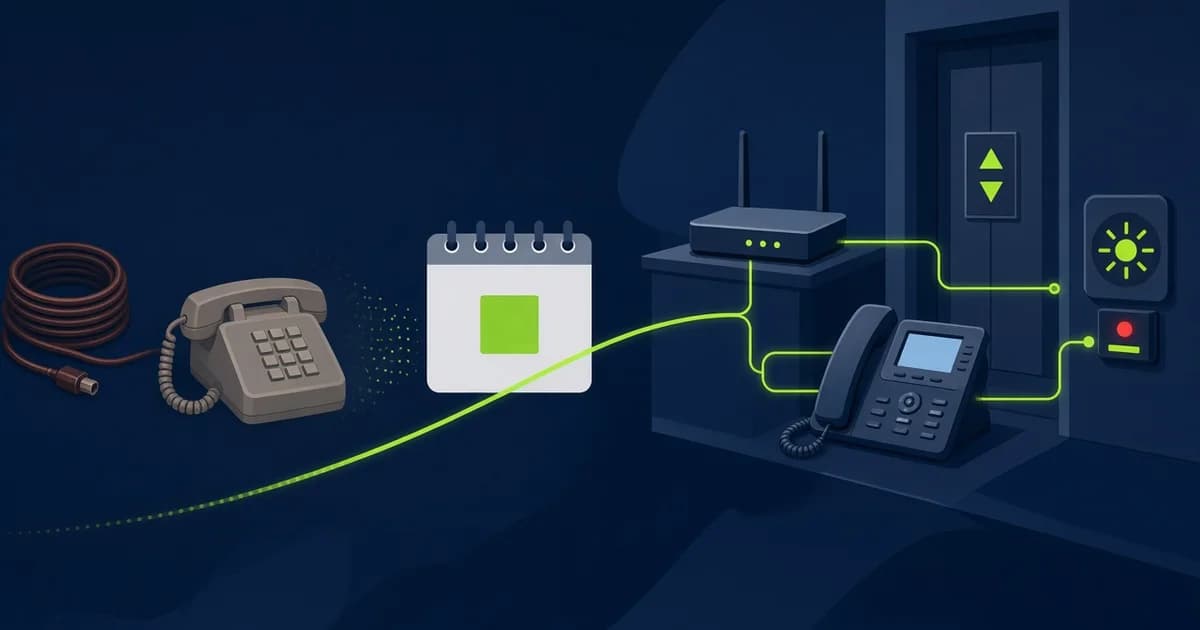
Updated 14 November 2026: rewritten for the final stage of the switch-off. The PSTN network closes on 31 January 2027, and that date is fixed.
The UK’s old copper telephone network, the Public Switched Telephone Network (PSTN), is being switched off. Openreach, which runs the network most UK providers use, will close it on 31 January 2027, and every line on it needs to move to a new service by that date.
If your business still has a traditional phone line, or equipment that uses one, you now have weeks rather than years to act. This guide explains what is changing, what is affected and what to do next.
What is the PSTN?
The PSTN is the analogue network that has carried landline calls over copper wires for more than a century. A phone plugged straight into the wall socket uses it. ISDN, the digital service many older business phone systems were built on, runs over the same infrastructure and is being retired at the same time.
Why is it being switched off?
The old network is ageing, harder to maintain, more vulnerable to faults and no longer meets modern needs. Calls are moving to digital phone lines that run over broadband, which give clearer calls, a more reliable service and better blocking of unwanted calls.
The timeline
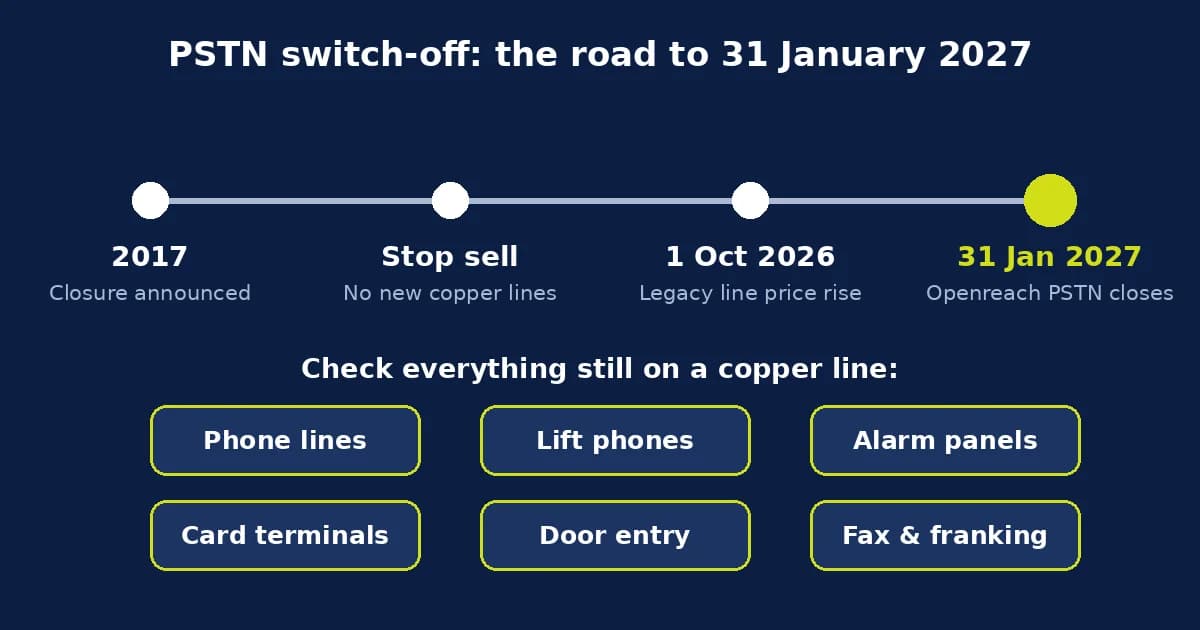
- 2017: the PSTN closure was formally announced, and most lines have since moved off the old network.
- Stop sell: in exchange areas where full fibre reaches most premises, providers can no longer sell new copper phone and broadband services.
- 1 October 2026: the final phase of wholesale rental price rises for legacy lines (WLR) and ISDN took effect, with further rises planned from February 2027.
- October 2026: a large number of copper-based lines were still active, many of them in business premises, and these are the most complex to move.
- 31 January 2027: the PSTN closes.
Not every network is on the same timetable. Virgin Media O2 and KCOM also plan to retire their old landline networks, but dates for those have not yet been set. If you are not sure which network your line uses, ask your provider.
What happens if you have not switched by 31 January 2027?
Lines that have not moved may be transferred to an emergency continuity service (EVAc). It is a limited, temporary, last-resort service that keeps basic voice calls working, and it may not support the calling features you use today. It also costs providers more than a normal line.
Where technically possible, linked broadband will keep running when a line is moved to EVAc, but this does not extend the deadline. For a business, relying on EVAc means risking lost features, higher costs and disruption to anything else connected to the line.
What replaces the PSTN?
Digital phone lines
For most homes and small offices, the replacement is a digital landline that works through your broadband router instead of the wall socket. You can normally keep your phone number and make and receive calls in much the same way.
VoIP and hosted phone systems
Businesses usually move to a cloud-hosted VoIP phone system. Calls run over your internet connection, and you get features such as call routing, voicemail to email, ring groups and mobile and desktop apps, so staff can take calls from anywhere. Older on-site phone systems (PBXs) connected to PSTN or ISDN lines need replacing or moving to SIP trunks.
Full fibre and SOGEA broadband
Broadband that currently depends on a copper phone line moves to full fibre or SOGEA, a broadband line that does not need a phone service attached. Full fibre is now available to most UK homes and businesses.
What is affected in a business?
Phone calls are the obvious part. The bigger risk is equipment that quietly uses a phone line. These are the systems most likely to be caught out:
- Card payment terminals (EPOS) and cash handling systems
- Lift emergency telephones and auto-diallers
- Fire alarm communication panels and security monitoring
- Door entry units, access control and automated gates
- Industrial telemetry and building energy management systems
Fax machines, franking machines and older on-site phone systems connected to analogue or ISDN lines are affected too.
Your phone provider will not know what is plugged into each line, so review your own devices and check whether they need replacing, upgrading or an adaptor. If a supplier suggests moving an alarm or terminal to a mobile SIM instead, check which network it uses, because 2G mobile networks are being retired too, starting from 2029.
What this means for a Greater Manchester office
Plenty of the remaining copper lines are in Northern England, and the lines still left are among the most complex to move. If your business is in an older or shared building, such as a converted mill, a multi-let office block or an industrial unit, look for lines that were put in years ago and are easy to forget.
Check lift emergency phones and fire or intruder alarm panels first. In a shared building these often belong to the landlord or managing agent rather than to you, so ask them which lines they use and when those lines will move. If your own alarm is monitored, ask the alarm company whether its equipment works on a digital line.
Card terminals and door entry systems at shops, workshops and reception desks come next. Your phone provider will not know they are there, so list them yourself and test each one after its line moves.
If you are moving your phones at the same time, our guide to keeping your number when moving to VoIP and our VoIP phone systems page explain the options, and our guide to comparing VoIP quotes shows what to check on price.
Power cuts and emergency calls
Old copper phones were powered by the line, so they often kept working in a power cut. Digital phones and routers need mains power. If you rely on your landline, have poor mobile signal or use telecare or health devices, you should tell your provider so they can arrange the right support, including battery back-up. For a business, a charged mobile phone and a clear plan for alarms and lift lines are the minimum. We cover this in more detail in what happens to business VoIP in a power cut.
What to do now: a checklist for businesses
- List every line. Check your phone bills for analogue and ISDN lines, including ones you have forgotten about in plant rooms, lifts and outbuildings.
- Find what is connected. Walk the building and note every alarm, terminal, door entry unit, lift phone and fax or franking machine that uses a line.
- Speak to equipment suppliers. Ask whether each device works on a digital line, and what an upgrade costs and how long it takes.
- Speak to your phone provider. Agree the migration date for each line and respond to any letters or emails about the switch. Ignoring them risks losing service.
- Choose your phone system. Decide whether a digital landline is enough or whether a hosted VoIP system would serve you better, and keep your existing numbers.
- Check your broadband. Calls will depend on it, so make sure the connection is reliable and consider a backup line or 4G/5G failover for critical sites.
- Test before the deadline. Test alarms, terminals and lift lines after each move, not on 30 January.
Common questions
When is the PSTN switch-off?
The PSTN closes on 31 January 2027. Earlier guidance mentioned December 2025, but the programme moved to January 2027, and that date is now fixed.
Can I keep my business phone number?
Usually, yes. Numbers can normally be moved to a digital line or a VoIP provider. See our guide to keeping your landline number when moving to VoIP.
Will call quality be worse?
Not on a reliable connection. Digital lines give clearer calls. Quality depends on your broadband and your office network, so it is worth checking both before you move.
Do I need broadband to keep a landline?
Not necessarily. Nobody has to lose their landline because of the change, and some providers offer an interim landline-only service for customers without broadband. Speak to your provider about the options at your address.
Is VoIP or a digital landline better for my business?
A digital landline replaces like for like. A hosted VoIP system adds features, mobile working and easier changes as you grow. Our comparison of VoIP and landlines for UK small businesses walks through the trade-offs, and our guide to comparing VoIP quotes shows what to check on price.
Need help before 31 January 2027? BM Technologies is based in Milnrow, Rochdale, and helps businesses across Greater Manchester audit their lines, move to VoIP phone systems and check the alarms, terminals and other equipment that depend on them. Call 0161 672 7461 or 01706 391 047, or contact us.
How we can help: IT support in Rochdale · IT support in Manchester · connectivity and internet.
Related reading
Business phone systems and VoIP · Keeping your number when you move to VoIP · VoIP during a power cut or broadband outage